Category Archives: Tea History

The Tea of Assam, India

Assam tea plantation worker carrying a basket supported from her head.

Assam Tea Plantation Worker, by Flickr User Akarsh Simha, CC BY-SA-2.0

Teas from the three main growing regions of India, Nilgiri, Darjeeling, and Assam, have become highly regarded over the years, forming the base to many popular teas including English and Irish Breakfast teas as well as great stand-alone specialty teas.  Known for its black tea, the Assam region produces tea with a distinct malty taste, known for its briskness (which by the way is another way of simply saying that its taste makes you sit up and take note vs having a flat, dull, or otherwise non-memorable taste).  Tea is produced in this region comes from some 600+ tea gardens and is manufactured both as CTC (crush, tear, curl) as well as orthodox or specialty tea.  The sheer volume of tea produced in Assam contributes substantially to making India the second largest producer of tea after China.  While known almost exclusively for its black teas, it should be noted that the Assam region of India also produces some green and white orthodox teas.
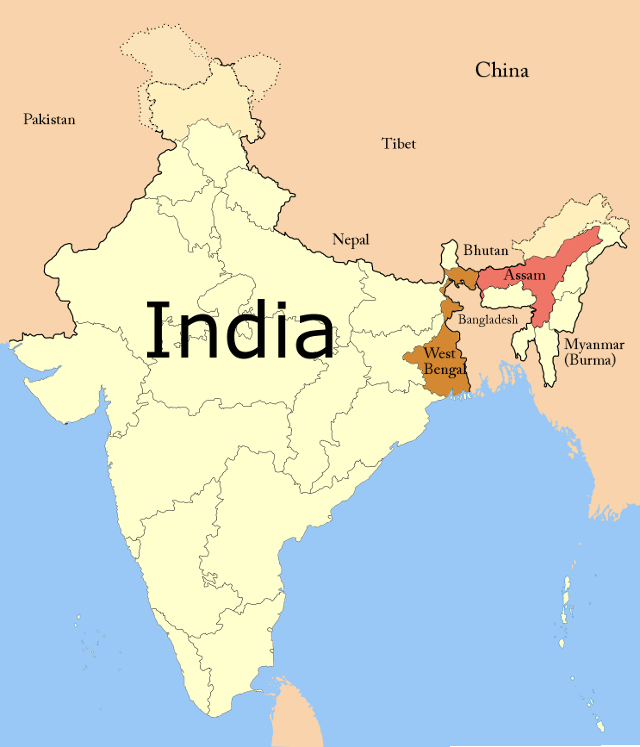
Assam Tea and West Bengal (Darjeeling Tea) India along with its neighbors.

Map of India with Assam Tea and West Bengal (home of Darjeeling) Tea Growing Regions

Assam Tea History

The history of tea in India likely dates back thousands of years, as it does for its neighbors in Nepal and China.  However, most agree that commercial development of tea in Assam began with the British in the 1830’s when Britain, and in particular the East India Company, which wanted to find cheaper alternatives to Chinese tea, started looking for tea and suitable growing conditions in other corners of the empire.  Since it appeared the climate was similar to that of tea growing regions in China, the British imported seeds and plants of Camellia sinensis var. sinensis, the variety found in China.  This, unfortunately for the East India Company, turned out to be a failure, as the variety wouldn’t grow successfully in India.  Around the same time, beginning in 1815, Major Robert Bruce discovered a plant in Assam that he thought was likely the tea plant growing in the wild.  It wasn’t until nearly 30 years later, in 1834 that his brother Charles Alexander Bruce successfully got testing and recognition that the plant was indeed tea.  As it turns out it was simply another variation of C. sinensis, the assamica variety.  Much more recently, using DNA sequencing techniques, research is suggesting that C. sinensis var. assamica (Assam), along with C. sinensis var. sinensis (China) and many other varieties, are in fact all related to a single parent from Mongolia, which migrated over time to give us the varieties we see today.

Assam Tea Garden, India

Assam Tea Garden, by Flickr User Bidyut Gogoi, CC-BY-2.0

Terrior of Assam Tea

It is the terrior found in Assam, combined with the C. sinensis var. assamica variety, which produces the significantly different taste that has become so highly regarded.  The leaves are larger in Assam and the nutrients in the soil lead to different taste and flavor compounds in the leaves.  Whereas in China tea is often grown at higher elevations, in Assam it is grown at low elevations along floodplains with sandy, nutrient rich soils which are typical of floodplains.  Also unlike tea grown in other parts of the world, it is the second flush, not the first, which is preferred.  The second flush is considered to produce a sweeter liquor with a more robust full bodied taste.

Given the proximity to other great tea production regions like Darjeeling, Nepal, and China, along with the historical thirst for tea driven by colonialism, it is really little wonder that Assam has developed to play a major role in the global tea trade.  We are looking forward to further exploration of Assam and the specialty teas to be found from this great region.

Trade as the Mother of Invention

Saint Emilion Grand Cru

Wine from the Saint Emilion region of France.

We are passionate about culture, history, and how many products and values are shaped by the interaction between people around the world.  This includes tea, and how it has shaped and been shaped by history and culture over thousands of years.  We referenced how the notion of terrior relates not only to tea but to wine and other products as well.

On a recent trip to France we were struck by yet another facet of history.  The notion that global trade, and the requirements associated with shipping products around the world have led to many of the great products we have today.  During our tour of wineries with TéléPro Tour in the Saint-Émilion region outside of Bordeaux, our guide noted that while wine has long been traded with England and others.  Over time, innovation led from clay vessels to wooden barrels and at one point someone noticed that the wine shipped from France to England tasted significantly better after shipment.  The difference forever changed wine production as producers determined it was the wine aged in oak during transport that produced exceptional flavors and aromas.  As a side note, the standard 75 ml bottle we see today came from the fact that the 225 liter barrel makes exactly 300 bottles if the barrel is full.

Men working on the Tea Horse Road carrying large bundles of tea.

Tea Porters by Ernest H Wilson, CC BY 2.0

For tea, much like wine, it was the necessities of transportation which led to the development of Pu-erh.  As early as 1600 BCE the road between China and Tibet and other locations was long and arduous, travelling over treacherous, high terrain.  It was used to transport goods for trade including sugar, salt, tea, horses, and of course culture and ideas.  Tea became important to the people of Tibet and similarly horses became important to China for military use.  Thus tea and horses were commonly traded via this road giving us the Tea-Horse Road by which it is known today.  This nearly 1500 mile journey would have taken a very long time to traverse and efficient transport of goods was a must.  So tea leaves began to be packaged into cakes.  This packaging allowed tea to be compressed and stacked for easier transportation by both man and horse.  Like wine, it was discovered that the tea actually had new flavors and aromas after the trip then at the beginning.  It turns out that time in the heat and humidity during the long trip along the tea horse road substantially changed the tea resulting in something like the pu-erh enjoyed today.

Tea bag.

Modern Tea Bag

Like aged tea and wine barrels before it, tea bags were also developed by accident as a result of trade between people separated by distance.  A far more modern development the tea bag was created by Thomas Sullivan of New York.  Upon receiving tea, Mr. Sullivan began to package teas in small silk bags in order to send small samples on to his customers.  Not realizing they should take the tea out of the bags some customers simply immersed in water.  When they reported back to Mr. Sullivan that the silk was a bit to fine, he realized the opportunity, switched to gauze and the tea bag was born.

Yet again, we find ourselves fascinated with tea, how it has been impacted throughout history, and has contributed to global culture.  Are there other analogous inventions you might be aware of, tea or otherwise?

$28,000 per Pound – Dragonwell Tea History

Map showing Zhejiang China where Dragonwell Tea originates.

Zhejiang, China – Home of Dragonwell Tea

Longjing, or Dragonwell Tea, is China’s most famous green tea. This tea is so prized in China that a pre-market release sale of Dragonwell in May of 2012, resulted in 500 grams of the tea selling for 180,000 Yuan or $28,499.  On a per gram basis, it was purchased at a rate higher than gold was trading that day.  On a per cup basis that is $171 per 8 oz of liquor, which is on equivalent to some of the more famous wines.  Tea purchased at this rate usually remains in China and exchanged between business men and politicians as gifts.

The name, Dragonwell, comes from Chinese mythology where a village in China was suffering from a severe drought and was advised to pray to the benevolent dragon who lived in the nearby well to bring rain.  The rain came and the village in appreciation renamed itself and its tea to Dragonwell.  Authentic Dragonwell is produced in Zhejiang providence outside of the fifth largest Chinese city of Hangzhou.  The area is also referred to as Xi Hu or the West Lake region and is home to several UNESCO sites, as well as tea plantations.  Due to the popularity of Dragonwell, the Chinese government expanded the region they claim as home to authentic Dragonwell to all of Zhejiang province.  Originally it was only produced in a 65 square mile area of Xi Hu, made up of four regions – Lion Mountain (Shifeng), the center of the original Dragonwell tea growing area, Mei Jia Wu (Mei family valley), Long Jing and Lin Yin Temple areas.  Given the popularity and relatively high price at sale, there are many counterfeit Dragonwell teas on the market, so knowing how the characteristics of the authentic tea is important.

Photo of Dragonwell Tea, its leaves and liquor.

Dragonwell Tea – Dry Leaf, Infused Leaf, and Liquor

Authentic Dragonwell is harvested by hand and then pan fried to stop the oxidation process.  High quality Dragonwell will be have uniform tight, flat lime to dark green dried leaves.  The steeped leaves will appear plump with a uniform light green color.  Lower quality Dragonwell leaves will turn bluish green to dark green in color after steeping.  The tea liquor should be a bright clear jade yellow.  This tea is best when brewed between 167-176 degrees Fahrenheit.  The North American Tea Championship definition describes the liquor of Dragonwell tea as having a gentle smell of fruitiness with mellow plant notes.  In the mouth, the liquor should have a light-bodied, buttery and smooth feel with slight astringency and hints of peas and sweet-corn with husk and a nutty finish.

I will admit the description above makes me roll my eyes and think how pretentious this sounds.  However, if you are lucky enough to get your hands on an authentic Dragonwell, the description barely does it justice.  It is a truly complex tea with a fabulous flavor worth slowing down to enjoy over multiple steepings.

There are many different types of Dragonwell on the market. Here is a quick list that does not cover all of them, but some of either the more common or special Dragonwell varieties.

Xihu Longjing This just refers to the region where the tea is grown.  This is the traditional region for Dragonwell.
Bird’s Tongue Longjing First growth picked on about March 21 yields a more intense aroma and taste of sweetness than the better known Ming Qian Longjing. Supply is highly dependent on the weather conditions and varies wildly year to year.
Bai Longjing Not a true Longjing but looks like one and is commonly sold as one, it is actually a Bai Pian. It comes from Anji in the Zhejiang Province.
Shi Feng Longjing A type of Xihu Longjing. Fresh tasting, its fragrance is sharp and long lasting. Its leaves are yellowish green in color, and easily imitated with excessive Pan frying of other green teas.
Pre-Qingming Longjing The premium early season first-picking known as Ming Qian or Pre-Qingming.  This tea is harvested before the QingMing Festival, which occurs around the 5th of April each year. The production cycle is very short, usually only ten days before Qingming every year.
Yuqian Longjing This tea is picked after QingMing but before the summer rainy season.  Its name translates to Dragonwell before the rain.
Qiantang Longjing This tea still comes from the Zhejiang province but outside of the Xi Hu district.

Even if you think you are not a green tea fan, Dragonwell tea is worth trying.  What is your favorite Dragonwell memory?

Korean Tea Set (Banner Image)

South Korean Green Tea

Infused and Loose Tea

Tea Photo from Republic of Korea

Like Japan and China, tea in South Korea has been very much influenced by Buddhism.  The introduction of tea to Korea initially occurred somewhere around the Goryeo Dynasty (918-1392 AD) at a time when the king would give tea as gifts to religious leaders and the military.  It was also incorporated into funeral rituals in the form of tea boxes placed with the deceased.  Unlike Japan and China, however, tea was not reserved for the upper classes and in fact was enjoyed by all classes in the country.

Tea, however, was not to last in South Korea.  At the start of the Choson dynasty, which ushered in Confucianism as the replacement for Buddhism, tea was pushed to the background.  Tea was heavily taxed, the tea fields destroyed, and many Buddhist temples destroyed.  What little was left of the tea industry in South Korea was crushed in the Seven Year War with Japan.  Most of the remaining tea fields were destroyed and many South Koreans skilled in pottery and other crafts were taken and forced to work in Japan.

Tea Set in Seoul Korea

Korean Tea Set

Though it had never died out completely, tea began its re-introduction in the 1800’s by Confucian scholar Chong Yag-yong who in turn passed along knowledge for drinking and producing tea to the Buddhist monk Cho ui who wrote a poem praising tea.  Then from 1945-1970 tea culture grew substantially with schools and universities devoted to tea and ultimately the writing of The Way of Tea by Hyo Dang. (Jane Pettigrew, 2008)

Tea Plantation

Green tea field in Boseong, Jeollanam-do South Korea

Today most tea is grown in the southern part of South Korea, with the Boseong area producing nearly 40% of all tea grown in the country. Virtually all tea produced in South Korea is green tea grown on plantations that were formed from the 1930’s onward (Boseong County, 2014).  Though tea production for the Republic of Korea is on the rise it still doesn’t rank anywhere among the top growers.  In 2012 the United Nations Food and Agriculture Organization estimates it produced 3,000 tons of tea while Japan produced 85,900 tons and China produced 1.7 Million tons (United Nations, 2014).

Tea production in South Korea is generally from new growth coming in April and May.  Tea produced before April 20th or Kok-u are referred to as Ujon and are the most sought after and highest priced.  Sejak is produced between April 20th and May 5-6, or Ipha.  After May 5-6 the tea produced is referred to as Chungjak with tea produced beyond May not considered to have the right qualities for good tea.

In Korea, like Japan, tea may be finished using industrial methods for drying and rolling or by hand.  There are two primary methods for crafting the finished products, resulting in Puch’o-ch’a and Chung-ch’a.  For Puch’o-ch’a the tea leaves are heated in an iron pan then removed and rolled, repeatedly alternating between heat and rolling until the finished product is produced.  For Chung-ch’a the tea leaves are immersed in near boiling water then removed and drained for several hours before being rolled and dried over a fire with no rest until fully dried (Anthony, 2014).

According to United Nations FAO statistics, the Republic of Korea production has generally been on the rise over the past ten years.  This is promising since Korean tea can only add to the breadth of experience in your tea experience.  South Korean tea can be had though one hopes for greater availability and diversity in the options over the coming years.

Have you tried South Korean tea?  What do you think of it?

Works Cited

Anthony, B. (2014, 04 3). Making Tea in Korea. Retrieved from Brother Anthony/An Sonjae: http://hompi.sogang.ac.kr/anthony/kortea07.htm

Boseong County. (2014, 04 3). Green Tea Plantation. Retrieved from Boseong County, Jeollanamdo, South Korea: http://english.boseong.go.kr/index.boseong?menuCd=DOM_000001404000000000

Jane Pettigrew & Bruce Richardson, B. R. (2008). The New Tea Companion. Perryville, KY: Benjamin Press.

United Nations. (2014, 04 3). FAOSTAT Gateway. Retrieved from Food and Agriculture Organization of the United Nations: http://faostat3.fao.org/faostat-gateway/go/to/download/Q/QC/E

Japanese Tea Culture

A number of years ago I had the opportunity to travel to Japan on business.  It was only for two weeks but I dare say it changed me, far more than any other foreign travel had to date.  Perhaps it was the right time in my life or perhaps it was being a bit overwhelmed traveling solo throughout Tokyo and Kyoto.  Either way, by the end of the trip I found myself a full on tea convert who loved sushi; very big changes in my life, which set the stage for me to look at Japanese tea culture a bit more closely.

Very old painting of Emperor Saga of Japan.

Emperor Saga of Japan (9th Century)

Tea made its way to Japan via cultural exchange back in the 9th century through religious interactions with China.  According to legend, tea was brought to Japan by a Buddhist monk who traveled to China and on returning home served it to Emperor Saga.  For his part Emperor Saga enjoyed tea enough that he supported the initial cultivation of tea plants in Japan even though it didn’t spread widely at the time.

Japanese tea culture really started to take shape in the 12th century.  At this time China had developed a new process which was better suited to the storage and transport of tea without it rotting.  This new process involved steaming, grinding and forming cakes of powdered tea.  One would then break a bit off the cake to make tea.  Another visiting Buddhist monk, Eisai, traveled to China and brought back the powdered tea, seeds, and knowledge to support the preparation of the powered tea.  Eisai is credited with the introduction of the tencha style of tea preparation, where hot water was added to the powdered tea, or matcha, and whipped into a thick froth.  Integration with religious ritual and adoption by ruling classes drove the import of more tea plants from China and cultivation expanded further.

Photo of frothy green tea made by whisking powdered tea and water.

Green Tea Matcha and Whisk by Kefisreal

Over time, the Japanese Tea Ceremony, also known as The Way of Tea, chanoyu, chadō, or sadō, developed as a distinct ritual.  Initially developed and performed by Buddhist monks, the ceremony has historically been performed by men.  According to Etsuko Kato, author of The Tea Ceremony and Women’s Empowerment in Modern Japan, starting in the 20th century, wealthy women and doctors began learning about tea and practicing the ritual, and today about half of those practicing chadō are middle class women and housewives  (Spinks, 2012)

It was around the 13th century that the game of tōcha developed, in which participants would taste teas and try to guess the region from which it came.  Held in a kissa-no-tei and hosted by a teishu, or tea gathering host, it was a betting game with the winners receiving luxurious prizes.  While tōcha started out as a game for elites, it ultimately helped spread tea gatherings across Japan.  (Greater Victoria Gallery of Art, 2014)

Photograph of Japanese Coffee House

Kissaten or Japanese Coffee House by Flickr user Melanie M

Finally, beginning in the late 1800’s, coffee began making inroads into Japan.  (Kuniko, 2002)  Today, there is much less observation of ritual as many in Japan, as in other countries, seem to have shifted toward a faster pace with more coffee.  Where tea and the associated ritual that comes with it used to sit one now finds the kissaten, or coffee houses, favored for the relaxed atmosphere and light fare, and more recently chains like Starbucks throughout.

Despite the increase in coffee however, tea continues to have immense popularity in Japan.  Almost all domestic production is consumed within Japan as loose leaf, matcha, bottled ready-to-drink teas, or other tea products.  In fact, a recent resurgence in popularity for matcha has even resulted in its importation from China.

What’s your take?  Have you been to Japan or are you from there?  Have you noticed any particularly interesting changes in the culture and ritual of modern Japanese Tea Culture?

Works Cited

Greater Victoria Gallery of Art. (2014, March 20). Tocha: A Game of Tea. Retrieved from Tea: A Journey: http://tea.aggv.ca/teachers-activities-tocha.asp

Kuniko, S. (2002, March 15). Coffee Shop Culture. Retrieved from Nipponia: http://web-japan.org/nipponia/nipponia20/en/topic/index.html

Spinks, R. (2012, April 28). Steeped in Tradition: Japanese Women and the Modern Tea Ceremony. Retrieved from ecosalon: http://ecosalon.com/steeped-in-tradition-japanese-women-and-the-modern-tea-ceremony/