Author Archives: admin

Nilgiri Tea Ice Cream (Vegan Friendly)

There is no better way to celebrate summer than to combine two of my favorite things, tea and ice cream. This would seem easy; there is green tea ice cream already. So why aren’t there black tea ice cream recipes all over the place?

The short answer is that green tea ice cream is made with matcha powder, so the tea is blended in with the cream allowing for a nice flavor, texture, and neon green color. When you are eating green tea ice cream, you are literally eating the tea. Black tea is not made into a powder like matcha, so to make black tea ice cream we have to borrow from the coffee ice cream recipes.

Photo of Nilgiri flavored ice cream being poured into churn.

Pouring Nilgiri Flavored Ice Cream into Churn

The trick behind good ice cream, thank you Alton Brown for this bit of information, is to find a nice balance of fat and sugar. If you want less fat, you need more sugar to help keep a smooth texture on the ice cream. It is also handy to note that the human tongue is not very good at picking up flavors in frozen items, so concentration of flavor is key. Keeping that in mind, I set out to find a simple ice cream base that could hold a strong cup of tea. Below is the recipe I came up with for Nilgiri Tea Ice Cream.

Why Nilgiri? It is the usual base to most iced teas in the USA. Its flavor holds up to ice, so it seemed like the easiest place to start.

1 quart Nilgiri Tea Ice Cream Recipe:

Ingredients

6 grams Nilgiri tea
8 oz of water
1 15oz. can of coconut milk (low fat coconut milk is fine, but double the arrowroot)
12 oz. of SILKEN tofu
¾ cup Brown Rice Syrup*
2 Tbsp of Vanilla Extract
½ Tbsp of Arrowroot powder (can use corn or potato starch here)

*Since I am not heating this mixture, it is safer to use a syrup than granulated sugar in this recipe. I am not a fan of high fructose corn syrup, which is why the brown rice syrup is here. Feel free to substitute the corn syrup, but the brown rice syrup adds a slight nutty flavor that compliments the tea in this recipe.

Directions:

Nilgiri flavored iced cream churning away.

Churning Nilgiri Flavored Ice Cream

Brew 6 grams of Nilgiri tea in the 8 oz of water for the typical 5 minute steeping time and set aside to cool slightly. Combine the rest of the ingredients and the tea in a blender and run the blender until the ingredients are combined and smooth. If you are like me and not very patient, the tea will have raised the temperature of the rest of the ingredients too high to immediately pour this into your ice cream machine. So put the contents of the blender in the refrigerator. It will probably need to sit there between 4-6 hours to drop it down to around 40 degrees Fahrenheit. Then follow your manufacturer’s instructions for pouring the mixture into your ice cream machine and churning it. It will come out a soft-serve consistency but will harden into more solid ice cream after about 4 hours in the freezer.

A hungry family is ready for dessert.

Nilgiri Tea Is Served

I hope you enjoy this as much as my family did. Have you tried using tea to flavor your homemade ice cream?

Cold brewing tea to filter for serving.

Cold Brewing Iced Tea

Brewing Iced Tea in the Sun

Sun Tea by flickr user SanFranAnnie, CC BY SA 2.0

As a native of Arizona, I spent most of my childhood drinking sun tea.  It was always an interesting sight to watch the tea bags infuse the water in the glass jar using just the rays and heat from the sun.  At the height of summer, it usually took no longer than a few hours for it reach the color my mother wanted.  When we moved to Florida, it was disappointing to learn that sun tea didn’t quite work there. So in came the countertop ice tea maker.  This remained my go-to method of getting quick black iced tea for many years.  Then I learned of cold brewing tea and quickly found this easy method opened up a whole new world of drinking some of my favorite hot teas cold.

Anyone with an iced tea maker will tell you it is impossible to get green iced tea out of it that is not horribly bitter.  As someone who steadfastly refuses to add anything to my tea, this was very disappointing.  The water is just too hot and the steeping time too long for the tea.  Even some of the best flavored teas lose their flavor in the ice tea maker; Jasmine tea being one.  Cold brewing these teas leaves their flavors intact.

Cold brewing iced tea to filter for serving.

Cold Brewed Iced Tea – Perfect for Summer

How to Cold Brew Iced Tea

It is super easy to cold brew tea.  You just need a pitcher and water.  The ratio is roughly 7 teaspoons of loose tea to 750 mL of water.  Put the loose tea and water into the pitcher and put it in the refrigerator for about 6-8 hours and see what happens.  The trick behind cold brewed iced tea is getting the liquid out at the end of brewing without the tea leaves.  That’s a piece of cake if you find one of the pitchers with mesh infusers at your local big box store.  Or if you happen to have 2 pitchers and a fine mesh strainer, you can strain the contents of your brewing pitcher through the strainer into the other pitcher and then discard your teas leaves, hopefully as compost for one of your favorite plants.  Play with the amount of tea versus water and your steeping time until you find the combination that works for you.

This cold brew method has been used in Japan for many years.  Not a surprise when you think about all the green tea Japan drinks.  So feel free to try this with your favorite green tea and see what you get.  This method also allows oolong to become a fabulous iced tea.  Those complex oolong flavors remain after brewing cold.

My favorite so far is cold brewed sencha iced tea.  It is really refreshing after a workout.  Have you tried cold brewing your favorite tea?  What do you think?  As we head into warmer weather we’ve highlighted the teas that we think will cold brew well for you on the Dominion Tea specials page.

Hillary @ Dominion Tea

The Tea of Assam, India

Assam tea plantation worker carrying a basket supported from her head.

Assam Tea Plantation Worker, by Flickr User Akarsh Simha, CC BY-SA-2.0

Teas from the three main growing regions of India, Nilgiri, Darjeeling, and Assam, have become highly regarded over the years, forming the base to many popular teas including English and Irish Breakfast teas as well as great stand-alone specialty teas.  Known for its black tea, the Assam region produces tea with a distinct malty taste, known for its briskness (which by the way is another way of simply saying that its taste makes you sit up and take note vs having a flat, dull, or otherwise non-memorable taste).  Tea is produced in this region comes from some 600+ tea gardens and is manufactured both as CTC (crush, tear, curl) as well as orthodox or specialty tea.  The sheer volume of tea produced in Assam contributes substantially to making India the second largest producer of tea after China.  While known almost exclusively for its black teas, it should be noted that the Assam region of India also produces some green and white orthodox teas.

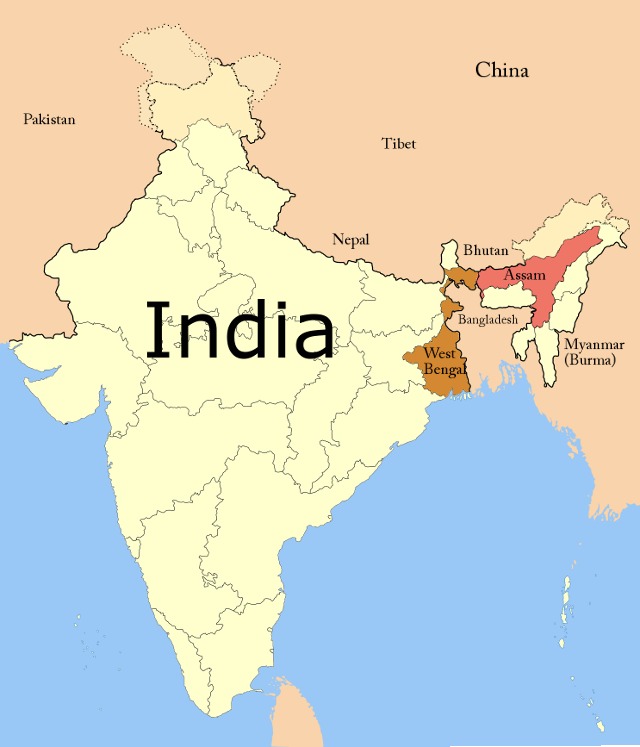
Assam Tea and West Bengal (Darjeeling Tea) India along with its neighbors.

Map of India with Assam Tea and West Bengal (home of Darjeeling) Tea Growing Regions

Assam Tea History

The history of tea in India likely dates back thousands of years, as it does for its neighbors in Nepal and China.  However, most agree that commercial development of tea in Assam began with the British in the 1830’s when Britain, and in particular the East India Company, which wanted to find cheaper alternatives to Chinese tea, started looking for tea and suitable growing conditions in other corners of the empire.  Since it appeared the climate was similar to that of tea growing regions in China, the British imported seeds and plants of Camellia sinensis var. sinensis, the variety found in China.  This, unfortunately for the East India Company, turned out to be a failure, as the variety wouldn’t grow successfully in India.  Around the same time, beginning in 1815, Major Robert Bruce discovered a plant in Assam that he thought was likely the tea plant growing in the wild.  It wasn’t until nearly 30 years later, in 1834 that his brother Charles Alexander Bruce successfully got testing and recognition that the plant was indeed tea.  As it turns out it was simply another variation of C. sinensis, the assamica variety.  Much more recently, using DNA sequencing techniques, research is suggesting that C. sinensis var. assamica (Assam), along with C. sinensis var. sinensis (China) and many other varieties, are in fact all related to a single parent from Mongolia, which migrated over time to give us the varieties we see today.

Assam Tea Garden, India

Assam Tea Garden, by Flickr User Bidyut Gogoi, CC-BY-2.0

Terrior of Assam Tea

It is the terrior found in Assam, combined with the C. sinensis var. assamica variety, which produces the significantly different taste that has become so highly regarded.  The leaves are larger in Assam and the nutrients in the soil lead to different taste and flavor compounds in the leaves.  Whereas in China tea is often grown at higher elevations, in Assam it is grown at low elevations along floodplains with sandy, nutrient rich soils which are typical of floodplains.  Also unlike tea grown in other parts of the world, it is the second flush, not the first, which is preferred.  The second flush is considered to produce a sweeter liquor with a more robust full bodied taste.

Given the proximity to other great tea production regions like Darjeeling, Nepal, and China, along with the historical thirst for tea driven by colonialism, it is really little wonder that Assam has developed to play a major role in the global tea trade.  We are looking forward to further exploration of Assam and the specialty teas to be found from this great region.

A Toast to Protecting Darjeeling Tea

Darjeeling Tea is grown in the Darjeeling regin of India

Darjeeling tea is grown in the Northeast of India surrounded by Nepal, Bhutan, and Bangladesh (Public Domain)

Darjeeling was the first tea in India to be protected under Geographic Identification (GI), which didn’t happen until 2011.  This protection allows India the right to force other governments to protect the Darjeeling name and product within their borders, which is quite difficult without the GI.  It is estimated that just before awarding the GI, there was almost 3 times more Darjeeling tea on the market than is actually produced in Darjeeling each year.  As a big fan of Darjeeling tea, this is both troubling and not surprising (it is a really good tea).  This tea fetches a price per pound almost fifty percent higher than Assam and Nilgiri and can rival the price per pound of some well-known Chinese teas.

What GI Means to Darjeeling Tea

By protecting Darjeeling tea, the Indian government not only ensures that the quality of the tea locally grown meets the definition of a Darjeeling but that it can stop tea being grown and manufactured outside of this area from being marketed as Darjeeling.   As an American, it is oddly ironic to learn that most of the counterfeit Darjeeling was being produced in China, which is often cited as the counterfeit capital for knock-offs of American movies, music, and high-end clothing lines.

In order to get the Geographic Identification, the India Tea Board had to develop a definition of what makes a Darjeeling tea.  It is defined as “Tea either currently being or having been cultivated, grown or produced in one of the 87 tea gardens in the defined geographic area of Darjeeling as determined by the India Tea Board, as well as processed and manufactured in a factory located in the defined geographic area.  When tested by expert tea tasters, it is determined to have the distinctive and naturally occurring organoleptic characteristics of taste, aroma, and mouth feel, typical of tea cultivated, grown and produced in the region of Darjeeling, India.”

The city of Darjeeling, India

Darjeeling, India, By SebaDella, CC BY 2.0 Generic

By creating the definition, the India Tea Board can license and monitor all stages of Darjeeling tea production to ensure quality and compliance with their certification.  As a consumer of the tea, it makes it simple to know if I am getting an authentic Darjeeling through the logo that is put on every pound of Darjeeling leaving the area for consumption.  The Tea Board is currently working with outside firms to automate as much of the oversight as possible, and through doing so, making it easier for the Tea Board to pursue counterfeiters and get their products off the market or labeled more clearly.  This ultimate helps to protect the growers and producers of Darjeeling by allowing the tea price to keep increasing as demand outstrips supply. If you have never had a second flush Darjeeling, you should.  It is a truly complex tea that has a medium to full-bodied feel with floral, fresh grass, muscatel flavors and a lingering finish.  The terroir of the West Bengal region India is credited for creating this complex tea given that it is a very high elevation area residing at the base of the Himalayas, home to the three highest mountain peaks on the planet.  It is the one place in India where Camellia Sinensis Sinensis is grown instead of Camellia Sinensis Assamica.

Mountainous Darjeeling tea plantation, India

Darjeeling Tea Plantation, By Shankar S., CC by 2.0 generic

Darjeeling Tea:  First Flush or Second?

If you are wondering why the second flush instead of the first?  The first flush is delicate, much more like a white tea and while still a wonderful tea, the second flush is where the flavor comes out in this tea.  The manufacturing process for Darjeeling is also unique because while it is marketed as a black tea its oxidation levels reside in the oolong range, which helps to draw out the flavors in this tea. So, I lift my tea cup to the India Tea Board and wish them luck in protecting this wonderful drink.  May all their hard work reap many rewards for the farmers and manufacturers of Darjeeling in the years to come.

Specialty Tea is Not a Commodity

There are a number of definitions for commodity but one we like states that “a commodity is any homogeneous good traded in bulk on an exchange.” (InvestingAnswers, 2014)  This definition goes on to say that for an item to be considered a commodity it must meet three conditions.

  • It must be standardized (for agricultural and industrial commodities it must be in a “raw” state).
  • It must be usable (i.e., have a shelf life) upon delivery.
  • Its price must vary enough to justify creating a market for the item.
Fields of wheat.

Wheat is a Commodity Like Oil and Gold

This works well for things like oil, gold, wheat and other products which can be produced in bulk, measured against well-known and agreed upon standards, and are usable for long periods of time.  Even though there are some differences in grades for each of these examples, they are by and large, equal to each other no matter where they come from and meet a standard definition of quality.  They are fungible.  You can generally intermingle all of them together and the buyer doesn’t know or care what the initial source of the product was.

Specialty Tea or Commodity Tea?

So how about tea?  I’ll go out on a limb (admittedly not very far) and suggest that there are really two major kinds of tea; commodity tea and specialty tea.  Commodity tea is produced in bulk by one of a half dozen or fewer global corporations.  Their aim is to sell a consistent product in massive quantities as inexpensively as possible.  The commodity definition breaks down a bit with tea, in that the product really isn’t raw at this point, as the raw leaves have been oxidized and macerated into fine pieces.  Even if it were sold raw, it wouldn’t be fungible since different cultivars and terroir produce significantly different taste.  It’s at this point where the tea markets like the one in Mumbai, India and Mombasa, Kenya play a role in getting teas of various taste to the small number of global players. It has been standardized in terms of the leaf size (or particle size if you prefer) and buyers are looking for specific taste profiles to be blended to produce that consistent taste they are going for.  This blended tea is ultimately packed into sacks for global transport, and sold in massive quantities.  Finally commodity tea is used in applications where consistent taste and low cost is the primary driver; mass produced tea bags, many ready to drink products, and health and beauty products.

Different types of specialty tea.

Specialty Tea Features Variety in Shape, Aroma, and Liquor Color

Where commodity tea defines quality in terms of consistent taste profile and particle size, specialty tea defines quality in terms of aroma, shape of rolled leaf, liquor taste, and sheer variety.  Specialty tea does not seek to maintain the same taste profile year over year.  Instead, specialty tea takes advantage of the uniqueness of its manufacturing process and variety in terroir.  It celebrates the differences between teas from different regions, countries, and elevations.  Consistent taste and lowest price are not the for specialty tea.  Instead the drivers for specialty tea are the story behind the tea, the desire for variety in flavor and aroma, and the degree to which one can appreciate where it comes from.  While this makes a clear definition of “quality” somewhat elusive, it encourages curiosity, learning, and experimentation, all key ingredients to a better tea experience.


Works Cited

InvestingAnswers. (2014, April 30). Commodity Definition & Example. Retrieved from Investing Answers: http://www.investinganswers.com/financial-dictionary/commodities-precious-metals/commodity-1035