Author Archives: admin

The Art of Preparing Tea for Use

“Tea being an infusion and not a decoction like coffee, it should be brewed not stewed, the chief object being to extract as much of the theine or refreshing principle as possible and as little of the tannin or astringent property as can be at the same time without either boiling or overdrawing it.”

Written by Joseph M. Walsh in 1896, Tea Blending as a Fine Art, provides a number interesting gems which stand out and make us appreciate the history, culture, and even the science behind the beverage. In this case, Walsh is making note that it’s important to revisit the basics now and then to ensure that consumers of tea are preparing it correctly in order to get the most enjoyment. Specifically, brewing or steeping tea is done relatively quickly, with the intention of extracting the various plant compounds which directly impart taste.

Theine (the Refreshing Principle) and Tannin

The theine or refreshing principle referred to by Walsh in 1896 was none other than caffeine and while it was eventually recognized as the same substance as any other caffeine, the extraction of caffeine remains a major objective for many of us who can’t pass a morning without at least one cup. However, tea, like grapes, contain tannin which in significant concentrations will yield a bitter taste. All true tea from the camellia sinensis plant contain both caffeine and tannin though the variety of plant, its growing conditions, and the contents of the soil (or terrior) have an impact on the amount. Additionally, the processing of the tea from a white through to an oolong and black significantly impacts the amount of tannin found in the leaves.

Extracting The Goodness from Tea Leaves

Steeping Tea Leaves Over Time

The Longer You Steep the More Flavor Compounds and Bitter Tannin Emerge – We Seek Balance

Apparently, back in the late 1800’s there were enough people steeping tea incorrectly that Walsh felt it was critical to teach consumers how it was done. First, he notes that “the consumer should purchase only the best tea, it requiring much less of the finer grades to make good tea than of the common kinds, and will prove the most economical in the end.” Walsh goes on to describe misconceptions that the strength of a cup of tea was measured by dark color, leading to practices like adding tea to cold water and bringing to a boil, or stewing tea in boiling water for a prolonged period of time. Both of these provide a dark liquor but also an extremely bitter infusion.

When steeping tea the goal is to use good quality water, at the right temperature, for just the right amount of time to get the best tasting cup of tea possible while minimizing the bitter qualities of tannin. For loose leaf tea this means three important things; using good quality water, keeping the tea in contact with the water for the right amount of time, and using the right temperature water for steeping. Good quality water ideally means soft water, freshly boiled. The water should certainly not be distilled nor should it have been previously boiled water that has been re-boiled.

Forlife Folding Handle Tea Infuser

Folding Handle Infuser

Separating the leaves from the water is also critically important. There are any number of ways to do this of course, using a reusable infuser or strainer or single use paper tea bag. For those more adventurous, a gaiwan, yixing teapot, or kyusu are great ways to steep tea in a more traditional way.

Finally, the right temperature is also very important. While boiling water works well for black tea and many oolongs, its isn’t the best for all types of tea. Using boiling water on green or white teas in particular will extract far too much tannin making your tea very bitter. With many teas, green, white,  and yellow in particular, steeping with cooler water often brings out far more favor.

Steeping Time and Temperature

Below you will find very general steeping times and temperatures when using a single serve tea bag or infuser. These are general guidelines however since, as we noted earlier, the amount of various flavor compounds and tannin can vary significantly from tea to tea based on plant variety, growing conditions, and processing.

  • White Tea – 170° – 185° for 1-3 minutes
  • Green Tea – 170° – 185° for 3-5 minutes
  • Yellow Tea – 160° – 170° for 4-5 minutes
  • Oolong Tea – 185° – 212° for 3-5 minutes
  • Black Tea – 190° – 212° for 3-5 minutes

If you don’t happen to have a thermometer readily available, fear not. Poured into a room temperature mug, boiling water will almost immediately drop the the high 190°’s. If you want to get water for green and white teas just wait 2-5 minutes before adding the infuser. For yellow tea, wait a bit longer, about 5-7 minutes before adding tea. Conversely, since boiling water will almost immediately cool, its best to pre-heat your mug for black and many oolongs by adding boiling water, discarding, and adding fresh water with the infuser already in the cup.

Lapsang Souchong – Smoky Tea

Lapsang Souchong was developed under Prince Regent Dorgon

Prince Regent Dorgon of the Qing Dynasty, China (Public Domain)

Lapsang Souchong is a smoked tea that originated in Wuyi Mountains in the Fujian province of China. Today it is made in various tea producing countries. The story of its creation has a few different versions but they generally agree that the tea was created during the early part ofi the Qing Dynasty out of necessity to either save the tea from impending bad weather or to hide it from invading troops that had entered the region as part of the effort to unify China under Prince Regent Dorgon. Either way, the tea leaves where smoked over pine wood to speed the drying process and then packed in barrels to store in mountain caves. Eventually it was shared with Western tea merchants who bought the tea and found that the Europeans loved it. So the following year, the merchants asked for more of the tea and offered a higher price for it than the traditional teas and a new product was born. Sometimes you will find references to Lapsang Souchong as “Westerner’s Tea” and while that may have been true to begin with, it is also consumed in China.

Lapsang Souchong is often enjoyed on its own but is also found in blends of  Russian Caravan. By the end of the 1600’s Russia had trade agreements with China that included exchanging thousands of pounds of tea for furs. Included in those teas where Pu-erh and Lapsang Souchong, as both teas weathered the thousands of miles of travel on horseback well.

Lapsang Souchong Production

Lapsang Souchong is made from the 4th and 5th tea leaves on the stem, the same ones used in some oolong and pu-erh teas. These are bigger leaves, allowing them to withstand the pine smoke for drying without losing their shape or their tea flavor. Some people suggest that these tea leaves somehow are of lower quality because they are not as delicate in flavor as the bud and first two leaves, but they neglect to give credit to these leaves for having a more consistent brisk flavor and the capability to hold their form under long travel.

The leaves are withered over pine wood fires (cypress is also used but pine is the original wood for this tea). The leaves are then pan fried and rolled. The rolled leaves are then packed into barrels and left to oxidize. Once they have hit the desired oxidation level, they are pulled out of the barrels, pan fried and rolled into long strips. Finally they are put into bamboo baskets and hung over the pine fire to absorb the flavors of the pine smoke.

Steeping Lapsang Souchong

Lapsang Souchong Infused Leaf

Infused Leaf of Lapsang Souchong

Steep this tea just like a black tea. It should be steeped for 4-5 minutes in boiling water. If the taste is a little strong for you, cut back on the initial steeping time by a minute or so. This tea produces a reddish brown liquor with a smoky smell and smooth full mouth feel. Due to the strong smoky taste, it can be steeped anywhere from 3-6 times before becoming weak.

While Lapsang Souchong tea has a tendency to produce very strong responses of either love or hate from tea drinkers (I love it, but David is not a fan), it is worth acknowledging its place in tea culture and giving it a try.

Puerh Tea and an Introduction to Dark Teas

Pu-erh Tea is truly fermented unlike other teas.

Puerh Tea (tuo cha) – Fermented tea formed into cakes and producing a very dark infusion.

If you’ve been exploring tea for a while you’ve undoubtedly heard a bit about puerh (aka pu-erh), or fermented tea, though you may not yet given it a try. If you consider yourself a regular tea drinker then puerh and dark teas really are a must for your tea ‘bucket list’. Originally from China, puerh and dark teas offer a very different experience. Smooth and earthy, this class of tea is produced using a very different process from other teas and offers a different taste profile which may even serve a as a great entry for coffee drinkers looking to add tea to their repertoire.

Unlike white, green, black, and other varieties of tea which are oxidized and heated or fired to stop oxidation, puerh tea is truly fermented. It develops, usually in the form of compressed tea cakes over years, developing flavor and becoming smoother the longer it ages. Unlike other teas, puerh is produced by partially heating tea leaves to stop most oxidation. Then they are rolled and bruised slightly before being processed into compressed forms. The compressed forms such as bricks, discs or cakes, and small birds nest shaped, called tuo cha, are then either artificially aged or left to age naturally, sometimes for decades.

Puerh Tea History

The development of puerh teas dates back many thousands of years to Yunnan province in China. The necessity of trade led to packaging of tea in compressed discs which could be more easily transported along the tea horse road and other trade corridors. At the time tea was traded for war horses and other goods and often traveled hundreds of miles over long periods of time. During the this time, in hot and humid conditions, the tea naturally fermented and turned into dark tea by the time it reached its destination.

Puerh and Dark Tea

Its often stated that the types of tea include white, yellow, green, black, oolong, and puerh tea. However, this isn’t really accurate. Puerh is actually one variety of dark tea, albeit the most famous one. In 2008, China recognized dark tea from Yunnan as being geographically protected meaning this is the only dark tea that can be called puerh despite the fact that a number of other provinces produce fermented dark teas using much the same process and tea plant varieties.

Steeping Puerh Tea

Steeping your puerh tea is relatively straight forward but is slightly different than other teas. While you should steep with boiling water like a black tea, you will likely be able to steep puerh at least four to six times if not upwards of 10-15 times depending on the variety. Wake up the tea initially with enough boiling water to cover the leaf and quickly pour off the liquor. If you are steeping in a pot or mug with infuser then use 3 grams of puerh or dark tea and steep 3-4 minutes and re-steep another 2-4 times. If you are using a gaiwan, use a bit more tea, about 5 grams, and steep the first time for 2o to 25 seconds. For each additional steeping at about 5 seconds more steeping until it becomes thin.

Although dark and puerh teas are unfamiliar to many western tea drinkers they can be a real treat. Unlike the other teas in your collection, if stored properly, with fresh circulating air, away from other smells and aromas, these will keep and mature for many years to come. And for those looking to make a switch from coffee, you may find both the color and flavor to be a logical first step.

There is much to explore with tea, and puerh as well. This was only an introduction to the world of dark and puerh tea. In the future we will explore more to include the world of counterfeit puerh, other regions producing dark teas, and more so stay tuned.

Black Tea Risotto

As winter seems to keep coming earlier than I want, I went into the kitchen looking for something warm, soothing, and filling. Nothing fits that bill like risotto. Now, I will admit I am usually looking for ways to make the everyday recipes my own and that is why I thought to replace the traditional stock in this dish with tea.

In figuring out which tea to use, it is helpful to remember that risotto gets its creaminess from both the butter added at the end of cooking and the starch released from the rice during cooking. So whatever tea is chosen needs to hold up against dairy and nothing does that better than a good strong black tea. I am sure an Assam black tea or Yunnan would have done fine, but I opted for one of our favorites, Kosabei TGFOP, a black tea from Kenya with both a malty flavor and slightly floral notes.

Experiments with Risotto using Black Tea

Black Tea as Stock for Risotto

Black Tea Risotto

  • 4-6 tablespoons room temperature butter*
  • 6½ cups water
  • 1½ tsps of Kosabei TGFOP (Yunnan Sunrise, Classic Assam, or other bold black tea would work too)
  • 1 medium onion
  • 1½ cups Arborio rice or another short grained rice
  • 1 cup shredded Parmesan cheese

*You can use oil, just use a lighter oil like corn or safflower, olive oil will overpower the tea flavor

First you will need to brew up your tea. Using a small stock pot or sauce pan, bring 6 ½ cups of water to a boil. Once it reaches a boil take the pot off the burner and then drop in all the tea. Allow the leaves to steep for 5 minutes and then pour everything through a strainer into a pitcher. Wipe any residual leaves out of the pot and then return the liquid to the pot. Put it over low heat so it stays warm while you are cooking the risotto. The best way to guarantee success with risotto is having warm liquid to pour over the rice.

Dice the onion into small pieces. Put a medium to large sauce pan (2 quarter sauce pan will give you more room to stir) on the stove at high heat. Put in 2 tablespoons of the butter and allow to melt. Add the onion to the butter and allow to cook for 3 to 5 minutes (the onions should look translucent). Stir periodically so your onions don’t brown. Then add the rice to the pan and cook for another 3-5 minutes. Stir occasionally to get the butter over all the rice and to evenly incorporate the onion. If using Arborio rice, when the kernels become clear around the edges it is the signal to start adding the tea.

Using a ladle, scope in one ladle of the tea and then stir until the liquid disappears. Then add the next ladle and repeat. Keeping going until you have roughly ½ cup left of the tea. Your rice should look plump and by in a slightly creamy sauce (it should not look soupy and the rice kernels should be apparent). Now add in the remaining butter 1 tablespoon at a time. If you cut the tablespoon into quarters it will melt faster. Also, this is where it is time to take a small taste of the risotto and see if you like the creaminess. It is not necessary to add all four tablespoons, it is more of a personal preference. Next, stir in the cup of cheese until it is fully incorporated.

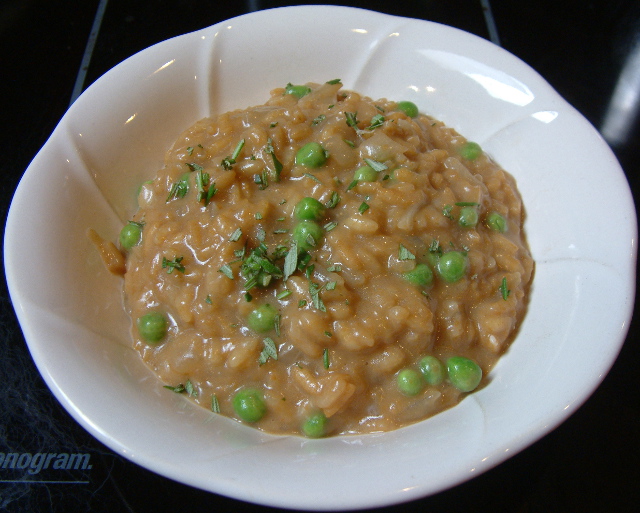
Black tea risotto with some peas and garnish.

The Finished Black Tea Risotto Dish

Now is the time to judge if the remaining ½ cup of tea is necessary. If the risotto is looking dry, try adding a little at a time until it looks shiny. You can also skip the last half cup and save it for the morning if you like the taste of the risotto and how it looks. Salt and pepper to taste and if you want you can stir in ½ to ¾ cup of your favorite vegetable and a couple teaspoons of herbs (rosemary and green peas is one of my favorite combinations in this dish).

I was surprised at how the warm malty flavor of a good black tea adds unique note to this creamy dish. Not to mention, it turns it a warm wheat brown color almost like a loaf of bread. I hope this inspires you to try using tea in one of your favorite recipes.

Preparing Tea with a Gaiwan

The Chinese Gaiwan adds new depth to your tea experience.

Bao Zhong Oolong Steeped in a Gaiwan

A few weeks back we highlighted the Japanese Kyusu, its history, and how to use it for brewing Japanese green teas. Among other things, the process of making Japanese green tea, which is steamed, instead of fired to stop oxidation, results in a wide variety of leaf sizes. The Kyusu, therefore, which typically has a screen inside the pot, serves to strain away all but the smallest of leaf particulate.

This week we are focusing on another specialized tea accessory, the Chinese gaiwan. If you love tea exploration then this is certainly a must-have item. Just like the Kyusu, the gaiwan provides another way to experience your tea, and really can make a substantial difference in both the taste and the experience. If you primarily steep your tea in an infuser or single use tea bag, the use of a gaiwan will undoubtedly bring out different flavors to your favorite teas (and perhaps even some of your less favorite too). Subtle teas, in particular, like many white teas, or in my case Bao Zhong seem to magically transform from being quite bland to flavorful and complex experiences.

History of the Gaiwan

Gaiwan with rolled oolong, ready for steeping.

Antique Gaiwan with Balled Oolong – Preheated and Ready to Steep

The gaiwan was created during the Ming Dynasty of China which lasted from 1368 to 1644 CE. During this period of Chinese history, noted for government stability and order, the Forbidden City was constructed and much of the brick and stone work of the Great Wall was laid. While scientific advancement lagged during this period of Chinese history, ceramics and porcelain had a boom, both in overall production and in the designs and colors used. This period marked the construction of a factory in Jingdezhen (southwest of Shanghai) that would ultimately produce almost all of the worlds porcelain for nearly 400 years (Facts and Details).

The gaiwan, literally meaning lidded (gai) bowl (wan) originally consisted of the bowl and lid, evolving over time to include the saucer as well. It was developed at a time when the use of tea leaves, instead of powder, started to become popular after the Yuan Dynasty (History of Tea). Steeping from leaves created the problem of separating leaves from the liquid and as it turns out, the lid of the Gaiwan works quite well to hold back leaves while drinking. It also works quite well to pour off the liquid entirely to another bowl or cup. The size of the cup itself is relatively small, though a perfect size for one person and it allows individual choice of water temperature and strength.

Holding a gaiwan.

One way to hold a gaiwan for pouring off the liquor includes the saucer and thumb on top.

Using a Gaiwan

There are many different ways one might use a gaiwan for steeping tea.  It can change depending on  the type of tea  (green, black, etc) used.  Then on whether one is leaving the leaves in, pouring the liquor off, using boiling water, a combination of cold and boiling water, using cooler water, and more.  All start with a rinse with boiling water that is discarded. This will clean it but more importantly it prevents a rapid drop in temperature of hot water when you begin steeping. After rinsing we prefer one of the following methods:

Steeping Green, White, or Yellow Tea in a Gaiwan

  1. Add 5 grams of loose tea to the gaiwan.
  2. Carefully, and gently, pour in water that has cooled to about 175° Fahrenheit.
  3. Wait 20 to 30 seconds.
  4. Drink directly from the gaiwan using the lid as a filter.
  5. Leave a small amount of liquid in the bottom and refill 2-3 times with slightly hotter water each time.
Alterantive method for holding a gaiwan.

Alternate method for holding a gaiwan without the saucer and your knuckle to hold the lid in place (can be quite hot).

Steeping Black, Dark and Puerh, or Oolong

  1. Add 5 grams of loose tea to the gaiwan.
  2. Smell the aroma of the leaf in the hot bowl.
  3. Add enough boiling water to just cover the tea and discard.
  4. Add boiling water, cover, and wait 20-30 seconds.
  5. Pour off the liquor into a cup or mug.
  6. Refill with boiling water to steep multiple extra times. For black tea this may be 2-3 times, oolong may be 4-6, and puerh may be as many as 15 times depending on the tea.

Finding a gaiwan is relatively easy on-line though driving to a shop to pick one up is going to be tough unless you live near the Chinatown neighborhoods of New York, San Francisco or other major city. Preparing your tea in a gaiwan provides a great way to learn about Chinese history. From a pure enjoyment perspective you will find that the use of a gaiwan will allow greater exploration of your tea from one infusion to the next. For some of your more delicate teas, you may find that it transforms a seemingly bland tea into a complex sensory experience and will become your go-to steeping vessel.

Sources Cited

Facts and Details, Ming Dynasty (1368-1644):  Porcelain, Pirates, and the Yongle Emperor, http://factsanddetails.com/china/cat2/sub2/item35.html

The History of Tea, Chinese Tea, http://www.china.org.cn/learning_chinese/Chinese_tea/2011-07/15/content_22999489.htm